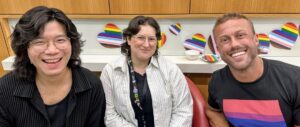
(L-R) Breandax Lim, Bella Bushy and Steve Spencer on Bidjigal and Gadigal Country at the Kirby Institute
The bi+ Sexual Health and HIV Study, known as the BiSHH, is a first of its kind, focusing on the experiences of those who are bi+ and multiple-gender attracted. The Kirby Institute team behind the BiSHH encountered interesting and unexpected challenges while developing the groundbreaking piece of work, causing them to rethink their design approach and how to meaningfully, yet practically, embed community consultation and leadership.
Featured
Bella Bushby is a PhD candidate and senior project officer in the HIV Epidemiology and Prevention Program at the Kirby Institute, UNSW Sydney. Her PhD focuses on the sexual health and HIV needs of bi+ people in Australia.
Steve Spencer is a co-investigator of the BiSHH, vice president of NAPWHA, founder and convener of BiPAN, the bi+ Positive Advocacy Network, appears as a regular guest lecturer on HIV lived experience at Johns Hopkins University and co-host of the popular podcast Give It To Me Bi.
Bella and Steve dedicate this episode to Dr Heather McCormack.
Transcription
Breandax: Bella, Steve, firstly, congratulations on publishing this groundbreaking and first of its kind study. Five years in the making, I heard? You must be on cloud nine.
Steve: Five years, minimum. It has been a long five years and a lot has happened, a lot has changed and, yeah, it’s just a wild ride and we’re not done.
Bella: I’m so happy we’re here though. I’m so happy the report is out and ready to be reviewed.
Breandax: I can tell you when you gave us all a little sneak peek at the ASHM conference last year, that was probably one of the most well-attended sessions that I saw at the entire conference and so many people were excited to see the results. But tell me first though, what is the BiSHH exactly?
Bella: The bi+ Sexual Health and HIV Study, which is affectionately known as BiSHH, was the first ever national survey that focused on the sex, relationships and sexual health of bi+ people in Australia. The survey was open late 2024 to early 2025 and we asked a range of questions related to sexual identity, attraction, sexual behaviour, relationships and sexual health. We also looked a little bit at general health, including asking about STI and HIV testing, experiences living with HIV and health service usage. We also included other aspects of health and wellbeing, such as alcohol and drug use, discrimination, sexual violence and coercion, mental health and social networks.
Steve: The deeper we got into it, the more we realised we have to cover really important areas, just really important areas.
Bella: Yes, and this was our opportunity to do that. Anyone who completed it would know it was a really long survey, but we’re so grateful for everyone who did complete it.
Breandax: The topics that we’re talking about though, Bella, we’ve had other periodical surveys that have looked at gender and sexuality and various elements of behaviour and health. And these surveys are also open to bi+ respondents. Why was there a need for something different though?
Bella: So, we do have a lot of research happening where bi+ people are included, which we love. And it’s important bi+ people remain included in these studies and we continue to promote for our communities to complete these surveys. (That’s a plug for work, sorry. Please do all our surveys!). But the main reason we really needed a dedicated bi+ study is because gender, sexuality and behavioural studies like these often combine bi+ people into wider groupings of LGBTQ+ people or they group bi+ people with lesbian or gay men. This could be due to not having a large sample size or when studies are not focused on sexual identity.
Steve: We see bi+ people have always been a hidden cohort within research and very rarely will we see data teased out. So, whenever I’m advocating as a community advocate within community health, I’m just always picking at little bits and bobs [of data] wherever I can. And now we finally have something really comprehensive and local as well. Local and world leading, I might add, for us to actually be able to use. A big part of this is what we do next with the research, [on] the advocacy side of things – what’s next? Now we can use that.
Breandax: It was interesting, you said there, that it was a first of a kind. How many respondents again?
Steve: Twenty-five hundred.
Breandax: Twenty-five hundred!
Steve: Dream! So, the next time someone says that bi+ people are hard to reach, I will say, nope, we got 2,500 of them, and there are more where that came from. It’s amazing.
Breandax: I mean, bi+ people is the biggest cohort under our beautiful rainbow community, so twenty-five hundred, that’s such an amazing response there.
Being a first of its kind, and I know that you’ve shared a little bit of the story with me, there’s been a nuance in the way that you had to approach designing the survey and then also promoting to try and get respondents on that survey there. But, it wasn’t a straightforward process. You started out with one idea and then found things along the way.
Steve: Myself and Eloise Monteiro, we were both involved with the Sydney bi+ Network, a grassroots community organisation. This is an example of community coming to research and saying, ‘hey, we would love this, this is what we want to see from you’. And the door was never closed, the door was always left a bit ajar. Then the stars aligned and Ben [Bavington] was just so gracious and so willing to hear us and so willing then to put so much time and effort and money into this project. This collaboration started from day one between bi+ people and our allies and then it grew from there. We built an incredible research team. We built an incredible community advisory group and then of course all of our bi+ respondents. It’s been bi+ led from day one.
Breandax: You mentioned that you had an advisory group. I’d love to understand a little bit about that story of how you assembled that and then also started to go on this journey with them between the researchers and ‘this is how we approach designing surveys and so forth’ and then what they were telling you throughout that process.
Bella: So, with this project, we knew from the start that we needed to have strong community involvement.
Steve: Yeah, I mean, even though we had so many bi+ researchers on the team, we don’t know everything. We could get through a lot of the questions and a lot of the concepts, but we really needed to pass things by the community advisory group because we have such a diverse community. So many diverse experiences that even a group of eight researchers with very diverse lived experiences was not enough. We needed many more people to be able to bring in their experiences and advise us. It was that exchange of ideas. And also, I might just say, like on a personal note as well, that there’s always a relief walking into a room with other bi+ people where we really get to nut out these ideas and actually really talk openly and honestly about our experiences.
Bella: To organise the community advisory group, we decided to do a national open expression of interest. We put it out there online and shared it through the community. We had people apply from across Australia. We went through that process and we ended up – we went to pick 10 people, but we couldn’t because everyone was so amazing so we picked 12 people who are bi+ community members from sort of all different diverse backgrounds to be a part of the research group.
Steve: Yeah and we found them through all the different bi+ community organisations, the Facebook groups, people we knew, a lot of it was word of mouth. It’s funny – ask bi+ people where other bi+ people are and we can find them. We know where we meet, we know how we communicate, we know where we are. And that’s sort of a demonstration of how this particular study is different to others because we are embedded within the community and so we know how to access this really vast amount of lived experience. And it wasn’t just lived experience either, they were experts. They were really experts.
Breandax: A common sort of hesitancy, I think, with co-design as a process is that it’s very labour intensive, there’s a lot of to and fro, and how to navigate decision making throughout that process. Tell me a little bit about that experience.
Bella: That was really important for us to address in this project and I think the way we approached this was making sure that we were all on the same page. We spent a lot of time working with the advisory group to really explain through with them the processes of research, what our scope was, what our limitations were, and how this sort of impacts the decisions we need to make.
Breandax: When you did come across sort of difficult decisions or where the research team had one idea and the advisory group was saying something different to that, how did you then work through that? How did you approach that conversation with the advisory group and find a way forward?
Bella: It was about really explaining why we could or couldn’t do changes based on their feedback. And a lot of it came down to sort of explaining how, even things like, how the online survey platform works and how data collection works once you have collected it and how you’re going to analyse it. Explaining the limitations to what if we were to pose a question in a certain way, the limitations to what that data would look like in the back end once we receive it and what we can do with it. I think having those discussions with the group and talking over in detail the pros and cons of each decision I think really helped get us all on the same page and make those sort of hardest decisions on how to collect the data. And a lot of it was around how to word things in the survey. It was about can you ask someone what their one single sexual identity is? So, we had a lot of discussions and we spent a lot of time talking through the best way to go about these and what that would mean for the data, what that would mean for community trust and the community’s experience doing the survey.
Steve: Yeah, I think the experience of the participant was always front of mind for us as well because we know very well any of us that have filled out the surveys that exist prior, it can be an experience of feeling erased, feeling not part of something or feeling like you’re not being seen as a whole person. Front of mind through the whole process was: how is this respondent going to feel answering this question? And are they going to come away from the survey feeling good? And the responses we got were incredible, the feedback we got.
Bella: Yeah, and this was the first time we had a bi+ sexual health survey. So, we really went crazy with it.
Steve: And people said it was like the first time they felt fully seen like ever in research. And it’s like, yes, yay!
Bella: And we did new things with the questions like, for example, just going back to that sexual identity question, we know a lot of people in our communities identify with more than one sexual identity. You know, feedback we had from the advisory group was, ‘you know, when I fill this form and I can only pick one, I feel like I’m not able to share my full self’. So what we did was, we broke it down and had a two-step question. We let people choose as many as possible, as many as they’d like of their sexual identity in the first question. Then in the second we said, and we made it really explicit, for data analysis we need to use one. We know this isn’t perfect, but if we are going to use one, which one would you like us to use? They’re the kind of examples of the nuance we sort of had to chat through with the group. And they helped us come up with these solutions.
Breandax: What a powerful example of, as researchers, bringing your expertise on the methodology and how to capture and translate things into this very – it’s very ‘science-y’ brain, numbers and data variables. It’s not how we would talk normally in everyday language. But then, I guess, listening to community about how that lands with them, what does it mean to them, how does it make them feel? Steve, you mentioned there, what a powerful example of that.
Bella: And I think there is room to make research better and I think there’s room to make changes to the systems to make it better for community. We were just really going in with that intention. And we had a lot of freedom in this project as well, especially with time. Like we had the time to go over this and make sure we got it right before we put it out.
Breandax: Now, you said you have the luxury of time, but I understand that it was a double-edged sword as well, because that luxury of time came from, maybe, the context of how this study was, or rather, was not very much funded.
Steve: Yes, indeed, it was. That’s the other miraculous thing about this. It was an unfunded study. We received a grant from Gilead Sciences.
Bella: And we had some funding from the Kirby Institute as well.
Steve: We did. And we had researchers on the team dip into their own pockets, into their own kitties to put money into this research. While we’re grateful for all of that, it’s also unacceptable, I think. I think it’s really important that when we’re looking at the group of people who not only make up the largest portion of LGBTQ+ people, but it’s the largest, the fastest growing cohort of LGBTQ+ people, we’ve got to start putting our money into it. But that’s difficult higher level discussions and hopefully that’s the seed that we can help sow as well. We’re making a proof of concept as well. It’s the first time it’s been done.
Bella: What was really important for us to do with that funding we did have, we used a lot of it on advertising the survey, but we used it predominantly to remunerate the community advisory group members for their time and expertise. Every meeting they attended, they received a gift card. Every round of feedback, they received a gift card. That was really important for us from the start to make sure people were remunerated for their time and expertise.
Breandax: So it sounds like the BiSHH was able to come together with some grants, Gilead, Kirby, but more or less, what is it, a wish and a prayer? A lot of wishes.
Steve: Haha an oily rag.
Breandax: The smell of an oily rag.
What do you think would help increase focus across funding, across research, across other areas of the health response to bring it to bi+ communities and their needs?
Steve: I’ll take a higher level look at it. Demographics are undeniable. We’re just seeing a wave of bi+ people, not only already existing and already the largest cohort, but coming at us. We look at Gen Z, Gen Alpha, the numbers of multi-gender attracted people are just extraordinary. Generation by generation, the numbers pretty much triple, double to triple. What that looks like into the future, we’re just not going to be able to deny it. So we have to get ready now. It would have been great to get ready 10, 20 years ago, but we’re taking the opportunity now. I think to be able to look at that and go to funders with that sort of information and then go to funders with the results that we have here, even though we don’t have, what’s really important here as well is that we have more research. We really need further research to be able to make that case.
Bella: We’re seeing in the data that young people are identifying as bi+ more than ever. I’m always thinking about sexual health and sexual health services. Those young people, if they’re more queer than ever before, they’re going to be entering sexual health services and we need to be prepared to respond to their needs.
I think a big takeaway or closing thing that’s really important from this is we really need to do more to raise awareness about bi+ communities. I think there’s a lot of misconceptions, there’s a lot of biphobia. And that’s basically a lot of the big picture thing that came out of this. A lot of people felt that services made assumptions about them. They didn’t feel like they fit in certain places. And like what we learned from the BiSHH study was that the bi+ community is really diverse in terms of gender, sexual partners, relationships, and we don’t all fit this one box.
Steve: We have to understand that each letter within our beautiful community has just completely unique experiences. And so what we might be seeing in the gay community where it’s sort of if I can say this, sort of post-identity, broader identity, there’s greater acceptance, there’s, you know, still high levels of homophobia, but, you know, it’s a comparatively well-served group. We can’t apply what we understand about that cohort with bi+ people because we’re actually seeing less people identify as gay and starting to identify as queer, starting to identify as more, moving them away from these sorts of things. And I’ve spoken to community advocates and leaders within community health about taking a post-identity approach and looking at a body parts approach, which is really important. But then what we see is people, the bi+ community is identifying. We’re moving, I like to say we’re sort of 20 years behind. We’re actually moving into the flag waving, you know, identity building, community building. We’re currently witnessing a huge, huge change. We’re witnessing the evolution and the creation of a bi+ identity and community.
And so, if we need to take that approach and the only way to understand that is by having bi+ people involved from research to applying the research within our community, health organisations, even in government, even with our funders. And trust me, if you enter a room and you want to talk about something bi+ – this is what I do if people are comfortable: I will invite people.
I remember one time I was at a national conference and I was very cheeky and said, ‘if anyone here is bi+ and would like to stand up and let the world know and make yourself seen, I’m going to stand up with you’. And a third of the room stood up! One of my friends, their boss turned to them and said, ‘I didn’t know you were bi’. And they’re like, ‘well, we just never talked about it. And I just never thought [about it], I don’t know’. This provides huge opportunities for not just visibility, but also to realise that we are here.
If we do look at our existing resources, our existing human resources across the sector, we’re looking at the incredible networks that were created of researchers, of community advisors across the country. We don’t have to reinvent the wheel. The wheel exists and it’s incredible. It has been world leading. The HIV response here is gold standard. And then what the BiSHH study has done is gold standard in community involvement and in bi+ research. So, let’s combine the two. It’s this exchange of ideas that will continue to make us a really lucky place to be in the world. We’re just so grateful, just so grateful for all of this.
I would really love everyone to understand that whilst it can be daunting, it can be very daunting to involve community and it might appear difficult, which it’s become a trope in itself. What we found in the BiSHH study is [that] it’s not only not difficult, it actually made our jobs a whole lot easier and it was enriching for every single person involved. And that’s because we really go back to the basics of what the HIV response in Australia is about. It’s about the meaningful involvement of affected populations. So, let’s meaningfully involve bi+ people. It’s about not leaving anyone behind. It’s about having people at the table at every step, at research, in governance, in how we apply our research and services, how we apply for our funding, which we’ll talk about. In clinical settings, bi+ people are already there and we also need to bring them in because we have to be prepared for the demographic changes that are coming. And I really, really, really want to tell the audience that you are capable and you are ready for this and go for it. And you’ve got an idea, put your hand up and just go for it. And we would appreciate you so much, whether you’re an ally or a bi+ person yourself. You got this.
Bella: Putting my data nerd hat on, I’d really like to see thinking more about how to include bi+ people in research and analysis, improving how we approach data to improve our ability to disaggregate differences and look at the differences in health outcomes between the LGBTQ+ communities within that umbrella. This requires dedicated research, which requires dedicated funding.
Steve: Ay, get that money, honey. Get that money, BiSHH. BiSHH 2.0 needs that money.
Bella: I’d really like to see, and I think what we’ve really learned from this study is there needs to be some more awareness around the diversity of bi+ communities. We need to increase bi+ representation. We need to understand and challenge biphobia to reduce biphobia and making assumptions, especially when it comes to relationships and sexual health about bi+ people.
I’d just like to say we’d really like to dedicate this episode to our colleague and friend, Dr Heather McCormack. Heather was instrumental in the BiSHH study. She was on the bi+ community advisory group and then moved into being an investigator. We loved working alongside her and we miss her very much.
Steve: Yeah, Heather, absolute legend. Absolute legend.
Access the BiSHH Study: