A New Education Tool Targets Testing Gaps and Better Care
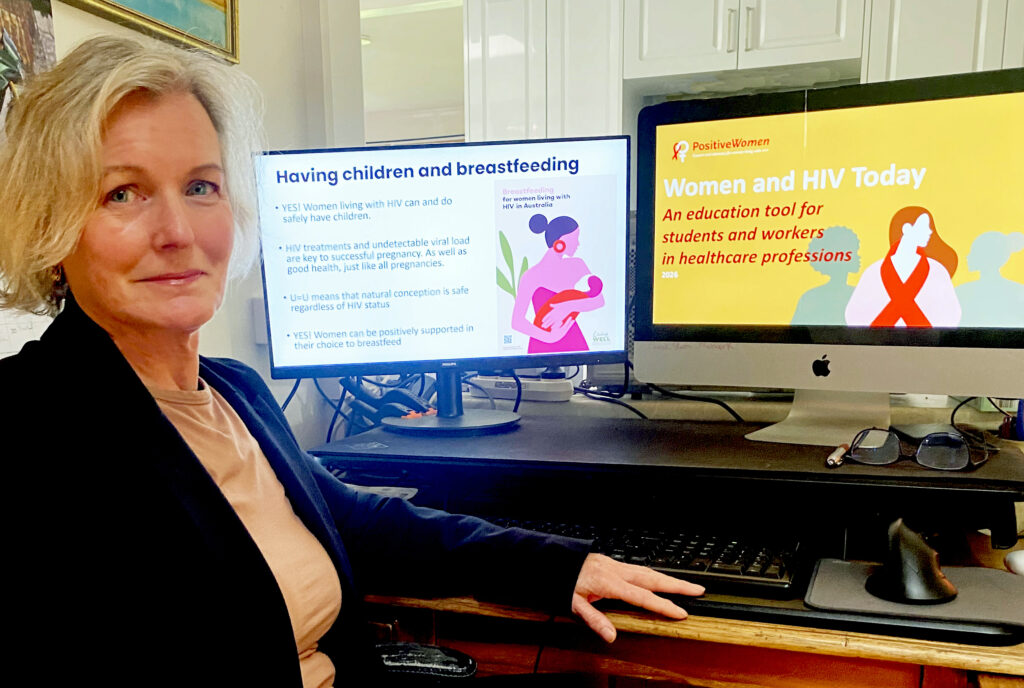
From missed diagnoses to gaps in ongoing care, women with HIV are too often overlooked in Australia, especially in regional areas. Many are diagnosed late, often in GP settings where doctors may lack up-to-date HIV knowledge. A new national audio-visual education tool, Women and HIV Today, aims to change this by equipping healthcare students and professionals with the knowledge to test earlier and care better for women with HIV. The project is being developed by Positive Women Victoria with a ViiV Healthcare Positive Action Community Grant awarded to NAPWHA (National Association of People With HIV Australia).
For decades, the story of HIV in Australia has followed a familiar script. Education, campaigns and clinical training have largely focused on gay men. As a result, women have often been overlooked in both testing and care. At Positive Women Victoria, we regularly hear from women who were diagnosed late despite presenting to doctors multiple times with symptoms that were dismissed. Many did not fit the narrow perception of who is “at risk” of HIV. Late diagnosis can lead to complex, long-term health issues, even when the virus is undetectable with treatment.
For women already living with HIV, experiences in general healthcare settings can be equally challenging. Outside specialist HIV clinics, some are treated as anomalies. Members have reported, in recent years, confronting misinformation and stigma from healthcare providers. Some of the experiences shared include unnecessary precautions such as double gloving during routine procedures like cervical screening, outdated beliefs about HIV being “curable” or “isn’t it like Hepatitis C?” and assumptions about their ability to work in public-facing professions like teaching. These experiences reflect a broader gap in knowledge that still exists across the healthcare system.
The Women and HIV Today tool aims to address this gap. While it may not reach every current practitioner, it is designed to educate the next generation by being embedded into university and training programs. The goal is simple: ensure that women presenting with symptoms or requesting a test are taken seriously, and that those living with HIV receive informed, respectful care beyond their HIV specialist appointments, which are either once every six months or yearly.
Having lived with HIV for nearly 30 years and worked at Positive Women Victoria for six, I’ve seen how persistent these gaps are. Like many heterosexual women, I did not see myself as at risk. Social taboos around discussing sex, particularly casual sex, often mean key information is never raised in a GP consultation. While this tool focuses on HIV, it also supports broader sexual health conversations, helping normalise discussions that are too often avoided.
The Women and HIV Today education project grew out of presentations Positive Women Victoria staff delivered to sexual health nursing students in Melbourne. We expected a solid baseline of HIV knowledge, but instead found significant gaps. If students specialising in sexual health lacked up-to-date understanding, what did that mean for general practice settings across the country? That question led us to develop this project and, through NAPWHA, successfully applied for funding under ViiV Healthcare Australia’s Positive Action Community Grant program, which supports community-led initiatives reaching populations most affected by or at-risk of HIV.
What the tool covers
Women and HIV Today is currently in development. It includes modules on HIV epidemiology, testing, treatments (including long-acting therapies), PrEP and PEP, the U=U (Undetectable = Untransmittable) message, pregnancy and breastfeeding, stigma and discrimination, and women ageing with HIV. The content combines clinical expertise with short videos from women living with HIV sharing their experiences.
This combination is intentional. Clinical knowledge alone doesn’t always shift attitudes. Lived experience brings a level of understanding that is harder to ignore and more likely to stay with the learner.
The risk of being “not at risk”
Women now make up more than 10% of the nearly 30,000 people living with HIV in Australia. At Positive Women Victoria, around 60% of our members were born overseas, representing 56 countries. For many, English is a second language and preventative healthcare may be unfamiliar, making informed and respectful care even more critical.
Most people with HIV in Australia see their specialist only once or twice a year, and even less in some regional areas. This makes the role of GPs, nurses and dentists essential. Yet many women are diagnosed in these settings at a late stage, often with little prior understanding of HIV.
That moment of diagnosis matters. It should be grounded in accurate, current information and delivered with care. Instead, some women leave with fear and misinformation. With the right knowledge, that same moment could provide reassurance, meaning that with modern treatment, they can live long, healthy lives, have intimate relationships including condomless sex, have children, and breastfeed safely.
Across Australia, around 38% of people living with HIV are diagnosed late. For women, that rises to 44%. For heterosexual men, rates are also rising so this tool can be adapted for men and rolled out in states like Western Australia where education for both healthcare workers, students and heterosexual men working in the mining industry are particularly needed. Data from the Kirby Institute shows that in 2024 there were 77 HIV diagnoses in Western Australia, with around half attributed to heterosexual transmission. Half of these estimated to be heterosexual men, with many linked to overseas exposure and a high proportion diagnosed late.
A pattern that isn’t shifting
Australia has made significant progress in reducing HIV transmission overall, but that progress has not been evenly shared. Among Australian-born gay and bisexual men, new diagnoses have fallen dramatically over the past decade. For women, the decline has been minimal.
Around 100 women are diagnosed with HIV in Australia each year. This is a relatively small number, but one that has remained largely unchanged. In a country working toward eliminating HIV transmission, this signals that current strategies are not reaching everyone effectively. More inclusive approaches to testing and awareness are needed.
Global factors and local impact
There are also emerging global pressures. Reductions in international HIV funding, including programs historically supported by the United States, are affecting prevention and education efforts in high-prevalence regions, particularly in Southeast Asia. For Australians who travel for work or leisure, this may increase exposure-risk over time.
A different kind of education tool
Women and HIV Today is designed as a practical, real-world resource. It will be embedded in university curricula and professional training, particularly where HIV is not covered in depth. It is also relevant to general practice and other healthcare settings where clinicians may encounter women living with HIV but have limited experience managing it.
The focus is on building confidence: when to test, how to have conversations, and how to provide care that reflects current science rather than outdated assumptions.
Why lived experience matters
A defining feature of the project is that it has been co-designed and will be delivered by women living with HIV. The rollout includes a pilot program of face-to-face education sessions across Australia, with presentations planned in metropolitan and regional locations.
For healthcare providers who rarely encounter HIV, this kind of engagement can be powerful. It creates space for questions, challenges assumptions and supports deeper learning.
Stigma in healthcare
Stigma in healthcare settings remains a persistent issue that even researchers are trying to address. Much of it stems from outdated knowledge or lack of exposure. Education is one of the most effective ways to address this, not only by improving understanding, but by reshaping attitudes.
What the future holds for the care of women with HIV and for testing in Australia
The aim of Women and HIV Today is straightforward: earlier diagnoses, better-informed care, and more respectful experiences for women living with HIV. By equipping current and future healthcare providers with accurate knowledge and real-world insight, the project seeks to ensure that no woman is overlooked, irrespective of whether she is seeking an HIV test or ongoing informed and respectful care.