On 3–4 November 2025, the Drug Policy Program Malaysia (DPPM), funded under Health Equity Matters’ SKPA-2 program, hosted a powerful Drug Policy Summit in Kuala Lumpur.
This summit brought together 170 participants from Malaysian government agencies, civil society organisations, expert bodies and individuals working tirelessly on issues related to drugs and drug policy. Fifteen international experts from the United Kingdom, Portugal, Australia, Indonesia and Thailand contributed their knowledge and experience to enrich discussions.
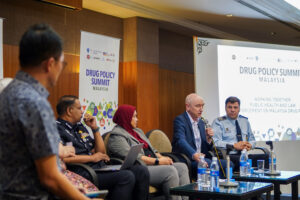
A panel of experts speaking at the drug policy summit
Malaysia’s drug crisis is worsening, driven largely by the rise in amphetamine-type stimulants (ATS), particularly methamphetamine.
The summit highlighted where the nation’s current punitive-based approach is falling short. This approach has been costly but ineffective, with 3.2 billion Malaysian Ringgit ($1.2 billion AUD) spent annually. Of this total, 1.15 billion Malaysian Ringgit ($430 million AUD) is spent on imprisonment alone.
In addition to this, corruption across the arrest-to-prosecution chain was highlighted as a major barrier to reform.
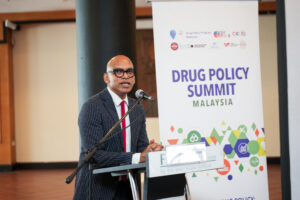
Palani Narayanan, Senior Program Manager at Health Equity Matters and the Director of the Drug Policy Program Malaysia
In a heartening shift in attitude, senior leaders within the country, including the Deputy Prime Minister, have acknowledged the seriousness of the issue, signalling openness to reform.
The summit underscored the need to shift from punitive, enforcement-based models toward public health, harm reduction and evidence-based approaches.
Professor Emeritus Dato’ Dr Adeeba Kamarulzaman, Chairperson of the DPPM, summed up the summit. She said:
The thought-provoking discussions, practical recommendations, and honest reflections offered by participants underscored a clear message: meaningful progress is possible when we come together with openness, compassion, and a willingness to reimagine a better approach.
Key roundtables from the summit included:
- Examples of decriminalisation and diversion from Thailand, Australia, Portugal, Indonesia, and the United Kingdom;
- The impact of our current laws on people’s lives. This was a deeply moving storytelling session that revealed how unjust and uncaring these laws can be, causing immense suffering to individuals and their families;
- Bridging the gap between law enforcement and public health;
- The impact of current drug policies on children and youth;
- The death penalty and the case for its abolition; and
- Emerging challenges related to ATS (amphetamine-type stimulant) use.
The summit is expected to serve as a catalyst that will spark reform in Malaysia. This hedges on key parties changing their approach to how to respond to the drug crisis.
Fundamental to this is recognising that punitive responses have not worked, because drug use and dependence are health issues, not crimes. By acknowledging people who use drugs as patients will encourage early treatment and recovery, reducing dependence and related harms.
Law reform is needed to reflect this understanding. Health Equity Matters will be watching with interest as Malaysian policymakers, civil society organisations, healthcare professionals, law enforcement, academia and communities come together to respond to the current situation. All parties must come to the table, and a collaborative solution is required. This includes people who use drugs, who need to be meaningfully included in decisions that affect their lives.

The Secretariat of the Drug Policy Program Malaysia and the organising team. From left to right: Shereen Sayed Ali, Nadia Zakaria, Prof Dr Adeeba (Chair of the DPPM), Palani Narayanan and Farid Zuhri
The DPPM will continue to engage with partners and stakeholders to advance the momentum generated by the summit, and support evidence-based reforms that protect health, uphold human rights, and strengthen communities.