Introduction
Fiji’s HIV epidemic among people who inject drugs is a public health emergency driven by syringe scarcity, low knowledge about HIV transmission and safer injecting, high-risk injecting practices, and systemic barriers to testing, treatment and care. In this crisis, self-determined leadership for people who use drugs (PWUD) is not just beneficial but essential. It means peers with lived-living experience design and manage the peer-led services needed to dismantle the barriers to HIV prevention, testing, treatment, and health care. By taking control over their own advocacy and harm reduction programmes, PWUD can directly address stigma, syringe scarcity, and systematic gaps enabling the epidemic, turning lived-living experience into effective action.
This article argues that moving PWUD from passive recipients to self-determined leaders—progressing through key stages of community empowerment—is not only a matter of justice but a prerequisite for an effective and sustainable HIV response in Fiji.
Background
Fiji faces a rapidly growing HIV epidemic, with new cases increasing twelve-fold from 2018 to 2024. Forty-eight percent (48%) of new cases in 2024 were linked to injecting drug use. Methamphetamine is the most injected drug.[i] Syringe scarcity drives high-risk practices including:
- receptive needle, syringe and ancillary equipment sharing
- preparing drugs by mixing with blood instead of water
- limited knowledge of HIV transmission and prevention among people who inject drugs.
With no needle and syringe programmes (NSPs) operating in Fiji, despite policy support, PWUD rely on pharmacies who often request prescriptions or identification to sell syringes, creating a black market for harm reduction equipment. Stigma, discrimination, and criminalisation deter people from accessing HIV testing and treatment. Fragmented health services lack integration with harm reduction programmes and support services for PWUD don’t yet exist. Peer-led programs are in their infancy and will need capacity building and support to mobilise PWUD in the response to HIV, viral hepatitis and sexually transmissible infections.[ii]
Despite supportive laws and strategies (e.g., Fiji National HIV Surge Strategy 2024–2027), harm reduction programmes have stalled. Difficulties coordinating multisectoral and government support and legislative change is hindering the implementation of evidence-based public health responses.
Why Self-Determined PWUD Leadership Matters
The global HIV response positions key populations living with and affected by HIV at the centre. Nothing About Us Without Us is a manifesto of PWUD that declares peers are best placed to inform and lead health programmes, services, activities and initiatives that affect us.[iii] Self-determined leadership doesn’t spontaneously occur. Instead, peer leadership is developed through a staged process called ‘the continuum of community empowerment’ (see Figure 1). As a process of shifting power relations, empowerment addresses “the underlying social, structural and economic conditions” [iv] that impact on the social determinants of health. The primary role of the AIVL—Australian Injecting and Illicit Drug Users League and Health Equity Matters activities and programmes in Fiji is to support the empowerment of key populations to play an active role in decisions that affect their everyday lives.
Figure 1: Author’s interpretation of Glenn Laverack’s Continuum of Community Empowerment (2007) with brief descriptions
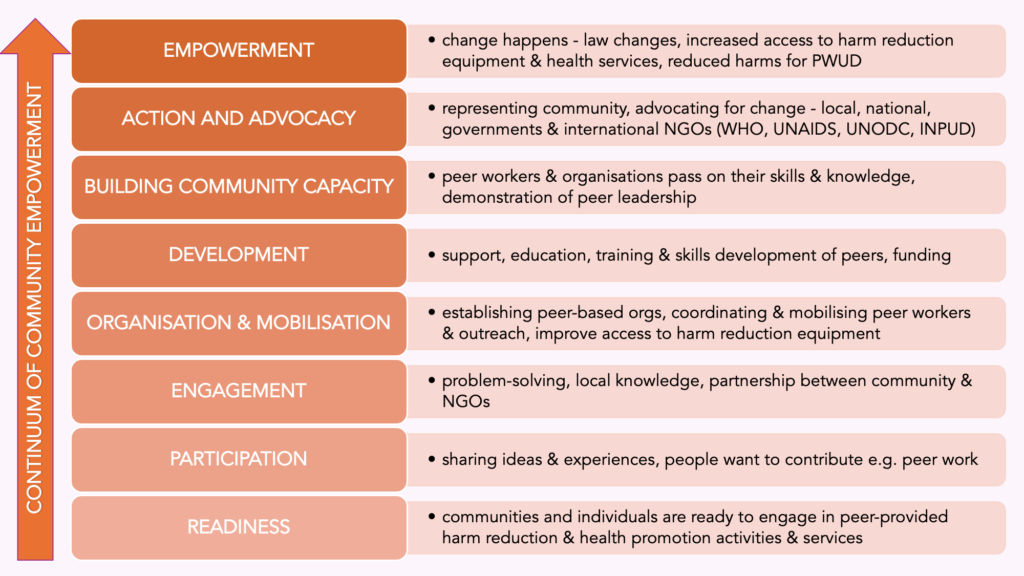
Empowerment begins with community readiness to work with partners to implement programmes and services in response to HIV. Peers then participate through active involvement to identify ideas and concerns, leading to community engagement in development of solutions, with partners support. Partners engage peers to coordinate financial and human resources and influence systems change. Through organisation, peers form peer-led movements and coalitions to mobilise themselves and with partners, secure financing for local responses through development assistance. Partners work to develop local peers and organisations skills, experiences and capacity.[v]
The next stage in the continuum, building community capacity, refers to peer-led organisations now being the educators of their peers to develop the skills, experiences and confidence for community action on issues of concern. Finally, the cumulative process leads to community empowerment where PWUD have control over decisions and resources that affect them.[vi]
Barriers to PWUD Leadership
Multiple structural barriers prevent PWUD from exercising self-determined leadership in Fiji. Criminalisation remains the most significant obstacle, with drug possession carrying severe penalties, which impacts upon PWUD access to health services.[vii] The ‘War on Drugs’ creates a climate of fear where peer leaders risk arrest, prosecution, and imprisonment simply for identifying themselves or advocating for their communities.[viii]
Stigma and discrimination compound these legal barriers. PWUD face prejudice from healthcare providers, families, employers, and the broader community. Stigma in Fiji is shaped by moral and cultural narratives that frame drug use as a personal failing rather than a health issue. Stigmatising media reporting reinforces harmful stereotypes, which undermines the legitimacy of PWUD voices in policy discussions and programme design.[ix]
Preventing HIV is about protecting health and dignity. If services are not safe or welcoming, people will not use them – no matter how strong the evidence is.
—Peer Worker, Angel’s Collective[x]
Resource constraints further limit PWUD leadership. Peer-led PWUD organisations are newly forming, lack funding, office space, training opportunities, and organisational infrastructure. When PWUD are included in consultations, their participation is often tokenistic, for example, being invited to meetings without decision-making power, adequate preparation time, or compensation for their expertise. Many PWUD don’t have the privilege of private health insurance or can afford out-of-pocket expenses, which account for one third of Fiji’s health financing arrangement (and rising).[xi] If restricted access to health services is the norm, then enabling peers to affirm their health and human rights will be needed to build demand among PWUD for HIV community health services. Even well-intentioned peer programmes operate in isolation due to health system fragmentation,[xii] unable to influence the broader structural determinants that shape health outcomes for PWUD.
What Enables Strong PWUD Leadership
Enabling authentic PWUD leadership requires deliberate investment in both capacity and systems change. Sustainable funding for peer-led organisations is foundational, providing the resources for office infrastructure, worker salaries, training programmes, and operational independence. Investment must extend beyond short-term project grants to multi-year core funding that allows peer organisations to build institutional strength and maintain continuity of leadership.
Policy reform, particularly decriminalisation of drug possession for personal use, removes the primary barrier preventing PWUD from organising openly and safely. Supportive legal frameworks, such as authorisation of NSPs, create enabling environments where peer programmes can operate without fear of police interference. The World Health Organization (WHO), UNAIDS and United Nations Office on Drugs and Crime recently published an updated Needle and Syringe Programmes for People Who Inject Drugs Operational Guide, which provides detailed evidence on the efficacy of NSPs and grounds the programme within global health best practice.[xiii]
A workshop held in Suva in November 2025, including participation from Fijian health and law enforcement ministries, clinical experts, community organisations, private businesses such as pharmacies, civil society, and peer experts, focused on the implementation of Needle and Syringe Programs (NSP). The workshop overwhelmingly showed support for the leadership of PWUD across all areas of NSP implementation. As we have seen in Australia, turning theoretical support into action is its own challenge. However, recognition for the importance of peers leading HIV and harm reduction from the design stage of NSP implementation is a positive sign.
Genuine partnerships move beyond tokenism to shared decision-making. This means PWUD representatives sit on governance boards, participate in budget allocation, codesign monitoring frameworks, and have veto power over programmes affecting their communities. Capacity-building—including leadership training, organisational development, financial management, and advocacy skills—equips peers to exercise this power effectively. Government and NGO partners must also build their own capacity to work collaboratively with PWUD, shifting from service provider mindsets to facilitation and resource mobilisation roles that support peer-led action.
Broader Impact on the Fiji HIV Response
Self-determined PWUD leadership transforms Fiji’s HIV response from fragmented interventions to comprehensive, rights-based programmes. Peer-led services inherently address stigma by normalising drug use as a health rather than criminal issue, and alongside the employment of peer workers, increases willingness to access, use and receive HIV testing, treatment, prevention, and harm reduction. Programmes designed by PWUD reflect the actual risk environments and survival strategies of people who inject drugs, making interventions more appropriate, acceptable, and effective.
Evidence globally demonstrates that peer-led harm reduction achieves superior outcomes: higher NSP coverage, increased uptake of HIV testing and antiretroviral therapy, reduced transmission rates, and stronger retention in care.[xiv] Community-driven responses also prove more sustainable, as peer networks provide organic pathways for information sharing, mutual support, and programme adaptation to changing drug markets and injection practices.[xv] By positioning PWUD as experts and leaders, Fiji can build an HIV response that is both more equitable and more effective in achieving better health outcomes.
Conclusion
Self-determined PWUD leadership is an essential foundation of Fiji’s HIV response. The progression from passive service recipients to empowered decision-makers through the requires systematic investment, policy reform, and genuine partnership. Overcoming barriers of criminalisation, stigma, and resource scarcity demands sustained commitment from government, development partners, and civil society.
Without PWUD at the centre of programme design and implementation, Fiji’s HIV response will continue to fail the communities most affected by the epidemic. With self-determined leadership, Fiji can build sustainable, rights-based interventions that reduce HIV transmission, save lives, and uphold the dignity and agency of PWUD. The question is not whether to invest in PWUD leadership, but how quickly Fiji can accelerate this essential transformation.